








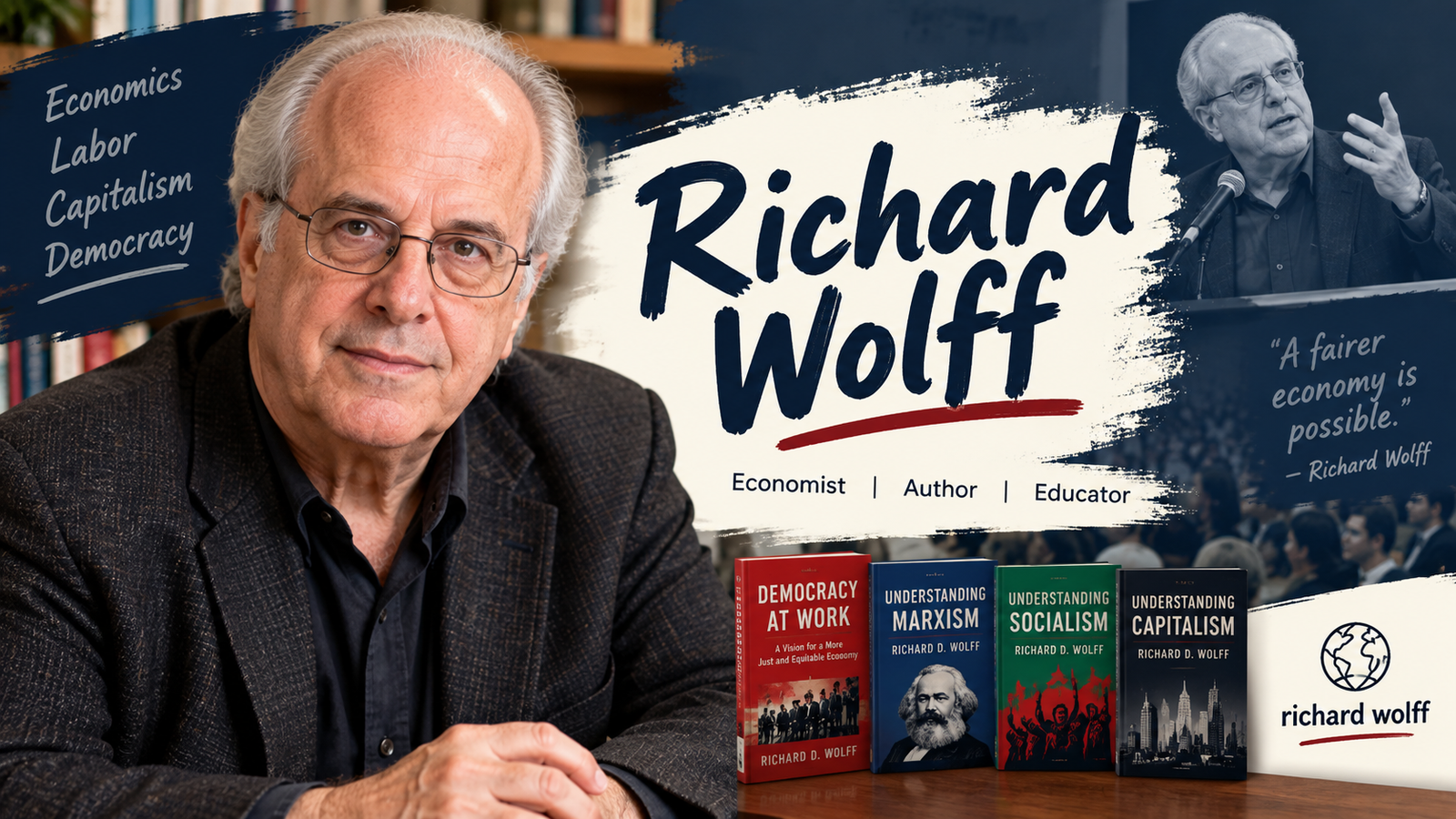
Richard Wolff has become a recognizable voice in public discussions about economics, capitalism, labor, and workplace democracy. Unlike economists whose work remains primarily within universities and academic journals, Wolff has spent decades bringing economic ideas to general audiences through books, lectures, interviews, and his long-running program Economic Update. His approach has made him a notable public intellectual, particularly among people interested in alternative perspectives on modern economic systems.
Who Is Richard Wolff?
Richard D. Wolff is an American economist and professor emeritus at the University of Massachusetts Amherst. According to his academic curriculum vitae, he earned a bachelor’s degree from Harvard University before completing graduate studies at Stanford University and Yale University, where he received his Ph.D. in economics in 1969. His academic career also included teaching positions at Yale and the City College of the City University of New York.
Wolff taught economics at the University of Massachusetts Amherst from 1973 until 2008. He later became professor emeritus and continued his work as a writer, lecturer, broadcaster, and public educator. Democracy at Work currently describes him as Professor of Economics Emeritus at UMass Amherst and a visiting professor in the Graduate Program in International Affairs at The New School in New York.
His career is notable because it combines traditional academic training with a strong presence outside the university environment. Rather than limiting his economic discussions to specialists, Wolff frequently explains complicated subjects in language designed for people without formal economics training.
His Academic Background
From Harvard to Yale
Wolff’s education took place at several of America’s most prominent universities. His academic record includes a B.A. from Harvard, master’s degrees from Stanford and Yale, a master’s degree in history from Yale, and a doctorate in economics from Yale.
This background gave him extensive exposure to economic theory, history, and political economy. His later work, however, developed a perspective that differs from much of conventional economic commentary in the United States.
Wolff has written extensively about Marxian economics and class analysis. His work examines how ownership, production, labor, and economic power shape societies. His interest in these subjects has remained central throughout his public career.
A Different Economic Perspective
Wolff is particularly associated with Marxist and heterodox approaches to economics. His books and lectures frequently question assumptions surrounding capitalism and explore alternative ways of organizing economic activity.
It is important to distinguish his views from a general description of economics. Wolff is an advocate of particular economic ideas, and his arguments are part of broader debates among economists, historians, political theorists, and policymakers.
That distinction helps explain why his work attracts both supporters and critics. His public profile comes not simply from discussing economics, but from presenting a clearly defined interpretation of how economic institutions operate.
Richard Wolff and Democracy at Work
One of the most important parts of Wolff’s public career is his connection with Democracy at Work, a nonprofit organization that produces media, educational material, books, and events focused on economic issues.
The organization identifies Wolff as its founder and describes its work as an effort to examine capitalism critically while advocating greater democracy inside workplaces. Its media projects include Economic Update with Richard D. Wolff, a program distributed through radio, podcasts, and online video.
The idea of workplace democracy is central to Wolff’s economic thinking. He argues that discussions about democracy should not stop at elections and government institutions. In his view, the structure of businesses is also important because employees spend a substantial part of their lives inside workplaces where major decisions are made.
His proposed alternative emphasizes worker-owned and worker-managed enterprises. Democracy at Work describes worker cooperatives as businesses owned and self-managed by their members, generally based on democratic participation and shared decision-making.
His Books and Major Ideas
Wolff has written and contributed to numerous books addressing capitalism, Marxism, socialism, and economic crises. Among his better-known titles are Democracy at Work, Understanding Marxism, Understanding Socialism, and Understanding Capitalism.
His writing style is often designed to introduce complex economic concepts to readers who may not have studied economics formally. Rather than relying exclusively on technical terminology, he frequently begins with familiar questions about employment, wages, ownership, inequality, and business decision-making.
His book Understanding Marxism explores Marx’s analysis of capitalism, particularly the importance of class struggle and the organization of production.
Understanding Socialism, meanwhile, examines different meanings and historical experiences associated with socialism and presents Wolff’s argument for workplace democracy as an important component of a contemporary socialist model.
His more recent Understanding Capitalism was published in 2024 and examines different definitions of capitalism, its institutional structure, and alternatives proposed by Wolff. A new edition of the book was also published by Haymarket Books in December 2025.
Why His Economic Commentary Gets Attention
Part of Wolff’s public appeal comes from his willingness to connect large economic concepts with ordinary experiences.
Questions about rent, wages, inflation, employment, business ownership, and economic inequality can seem abstract when presented through statistics alone. Wolff frequently approaches them through everyday examples, asking who owns productive assets, who makes important decisions, and how economic gains are distributed.
This approach has helped him build an audience beyond conventional academic circles. Democracy at Work describes Economic Update as a weekly hour-long radio program and online series hosted by Wolff.
His public communication also reflects a broader change in how people consume economic information. Podcasts, streaming video, interviews, and social platforms have created opportunities for academics to reach audiences directly without relying entirely on traditional newspapers, television networks, or university publications.
Richard Wolff in the Public Conversation
Although Wolff is an economist by profession, his public work frequently overlaps with discussions about politics, labor, business, and social organization. He has appeared in interviews and public forums where economic issues are discussed alongside wider questions about society.
That visibility has made him a familiar figure among audiences interested in progressive and Marxist economic thought. At the same time, his positions should be understood as his own analytical and political-economic perspective rather than as a consensus view among economists.
His public career illustrates how economists can occupy very different roles. Some focus mainly on academic research, while others become teachers and communicators for broader audiences. Wolff has strongly embraced the latter role while continuing to draw upon his academic background.
A Lasting Focus on Workplace Democracy
Perhaps the most distinctive feature of Wolff’s work is the attention he gives to the internal structure of businesses.
Traditional debates about economic policy often focus on taxation, government spending, interest rates, trade, or regulation. Wolff adds another question: who controls the workplace?
His answer centers on worker self-directed enterprises, sometimes described as worker cooperatives. These organizations would give employees a direct role in decisions concerning production and the use of business resources. Democracy at Work presents this model as a central part of Wolff’s proposed alternative to conventional capitalist enterprises.
Whether readers agree with this approach or not, it provides a useful way to understand the central theme running through much of his work: economic institutions are not simply technical arrangements. They also determine who has authority, who participates in decisions, and who receives the results of economic activity.
Frequently Asked Questions
Who is Richard Wolff?
Richard D. Wolff is an American economist, professor emeritus at the University of Massachusetts Amherst, author, lecturer, and host of Economic Update. He is widely known for his work on Marxian economics, capitalism, socialism, and workplace democracy.
What is Richard Wolff known for?
He is best known for explaining Marxian and heterodox economic ideas to general audiences and for advocating greater democracy in workplaces. His books and media work examine capitalism, economic inequality, worker cooperatives, and alternative economic systems.
What is Democracy at Work?
Democracy at Work is a nonprofit organization associated with Wolff that produces educational and media content about economic systems and workplace democracy. Its projects include Economic Update with Richard D. Wolff.
What does Richard Wolff say about worker cooperatives?
Wolff argues that worker-owned and worker-managed enterprises can provide a different structure for economic decision-making. The model emphasizes democratic participation by workers rather than concentrating authority solely among owners or corporate executives.
What books has Richard Wolff written?
His notable books include Democracy at Work, Understanding Marxism, Understanding Socialism, and Understanding Capitalism. His publications cover economic theory, capitalism, Marxism, socialism, and possible alternatives to existing economic arrangements.
Conclusion
Richard Wolff occupies a distinctive place in modern public economics because he combines extensive academic training with an unusually broad public education role. His career has moved from university teaching into books, broadcasting, lectures, and organizational work focused on questions about capitalism and workplace democracy.
His economic arguments remain part of ongoing debates rather than settled conclusions, but his influence as a communicator is clear. By explaining complex subjects through questions about work, ownership, class, and economic power, Wolff has encouraged a broad audience to think more deeply about how economic systems function.
Whether someone encounters his work through a book, lecture, interview, or Economic Update, understanding his background helps put his arguments into context. His central concern remains remarkably consistent: how economic institutions are organized, who controls them, and what alternatives might look like.